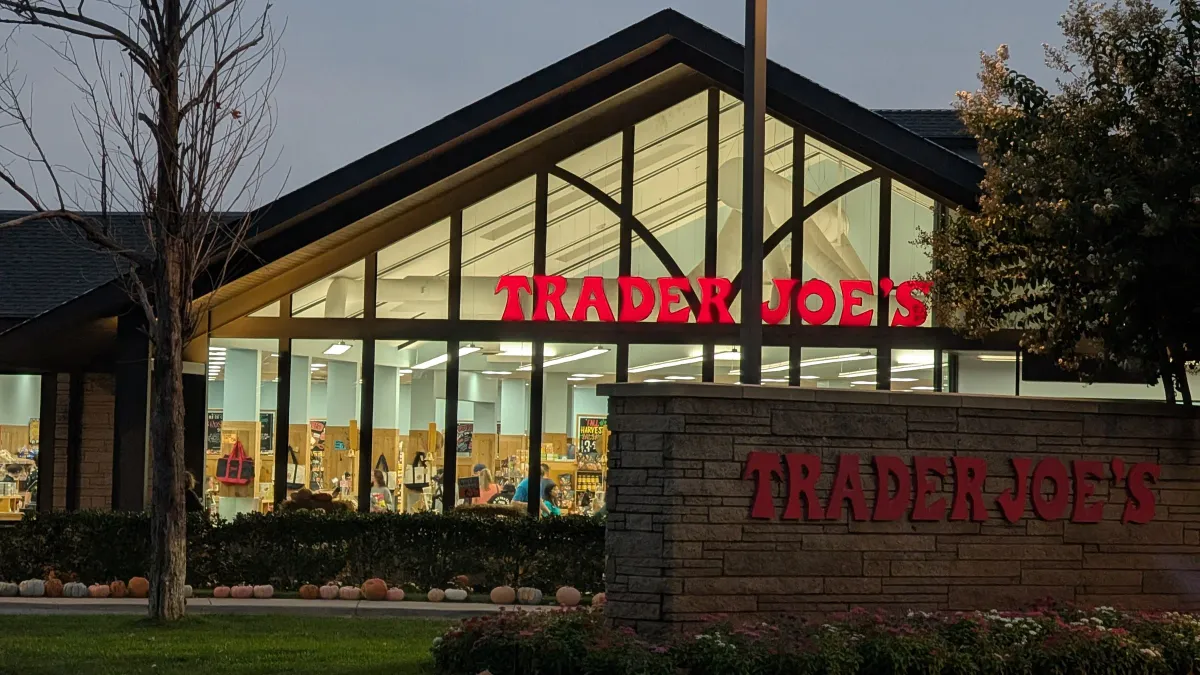
Two grocery questions come up more than any other when I am out talking with people around Harrisonburg. When is the new Kroger opening, will the one on East Market Street stay, and why don’t we have a Trader Joe’s?
I have repeated a few theories on the last one myself over the years without checking them. This month I did the checking. Here is what is on the record, what is folklore, and what I think it means if you own a home here.
First, the Kroger
Harrisonburg already has a Kroger, on East Market Street. What is new is a second and much larger store. A 99,000 square foot Kroger Marketplace is proposed at the corner of Stone Spring Road and Spotswood Trail (US 33), on the Rockingham County side of the line just outside Harrisonburg city limits. The site plan was submitted in late 2025. As of early August 2026 the county still listed it as under review, and the county administrator said the review was close to finished. The hold-up was a traffic and signal study, not a problem with the project itself. Once the plan is approved, building permits typically follow within a few weeks, and then the site can break ground.
No opening date has been announced, and I have not seen anything newer than August.
Will the East Market Street Kroger stay open? Kroger has not said, and I would not expect an answer until the new store has an opening date. The two sites are only a few miles apart on the same side of town, which is exactly why people ask. What I can say is that the current store was not part of Kroger’s 2025 round of closings, which hit Charlottesville and Abingdon in Virginia. If Kroger announces anything about East Market Street, I will update this post.
So the new Kroger is real, it is moving, and it is slow. That is a normal pace for a project that size.
What Trader Joe’s actually says
Trader Joe’s is a private company and does not publish a site-selection formula. But its executives have talked about the process on the company’s own podcast, and the pattern is consistent.
- The pipeline is long. In a 2022 episode the real estate team said it had roughly 200 sites under consideration; by 2024 the company said it was looking at more than 1,000. About one in five sites that brokers submit passes the first screen, and about half of those become stores.
- The factors they name are population density, traffic patterns, parking, household counts, and distribution, plus the ability to staff a store. A site has to check every box on size and access.
- They prefer to grow outward from existing stores that are doing well rather than jump into new regions.
- They open a few dozen stores a year nationwide: 34 in 2024, 43 in 2025, and the company has said it plans more than 20 in 2026. With roughly 660 stores in the country, that is a slow, deliberate pace.
- On petitions and letter campaigns, the podcast hosts have been polite but direct: being wanted matters to them, but those campaigns usually do not change a decision. A 2017 petition for a Harrisonburg store gathered about 1,400 signatures. Two public Facebook groups started in 2024 have about 360 and 150 members and spent that spring asking everyone to fill out the company’s request form. I did not find a reply from the company in either group, and both have been mostly quiet since 2024. That is not a knock on the people who started them. It is what the company itself says to expect.
The founder, Joe Coulombe, was blunter in a 2011 interview, saying the stores would not work without enough well-educated people nearby. He described his target customer as overeducated and underpaid.
What the numbers say about Harrisonburg
Trader Joe’s lists stores in 17 Virginia cities. They cluster in Northern Virginia, Richmond, Hampton Roads, Williamsburg, and Charlottesville. The company has confirmed a Fredericksburg store with no date yet. There is nothing in Roanoke, Lynchburg, Blacksburg, Winchester, Staunton, or Harrisonburg. Roanoke’s parks department runs bus trips to the Charlottesville store.
Here is how our metro compares to college towns and small metros that have a store, and two that do not. Figures are from the Census Bureau’s 2020 to 2024 American Community Survey. Each line gives metro population, median household income, and the share of adults with a bachelor’s degree.
No Trader Joe’s
- Harrisonburg, VA: 137,000 people, $75,100, 32%
- Blacksburg, VA: 181,700 people, $65,800, 36%
- Bloomington, IN: 162,600 people, $65,500, 44%
Has a Trader Joe’s
- Athens, GA: 220,200 people, $65,600, 43%
- Charlottesville, VA: 224,300 people, $93,600, 54%
- Boulder, CO: 329,000 people, $104,000, 64%
- Asheville, NC: 414,700 people, $71,800, 43%
Two things stand out.
Size. Every metro on the list with a store has at least 220,000 people. Harrisonburg and Rockingham County together are about 137,000, and the 2025 estimate is just over 140,000. JMU’s 23,000 students are counted in that, but students do not show up as the kind of household counts the company says it looks at.
Education share. Harrisonburg’s metro has the lowest share of adults with a bachelor’s degree of any area on the list, including the two other college towns without a store. Our household income is actually higher than Athens or Asheville. On that measure we are not the problem. On the measure the founder himself named, we are at the bottom of the list.
The honest read: on the company’s own stated factors, Harrisonburg looks like Blacksburg and Bloomington, not like Charlottesville or Boulder. A metro that is growing, with more households inside a short drive of a site, is what changes that math, and that is happening here slowly.
The Aldi connection
The story I have told at dinner parties goes like this: Aldi and Trader Joe’s are owned by the same family, so if we can support an Aldi, we should be able to support a Trader Joe’s. The first half is true. The second half does not follow.
Brothers Karl and Theo Albrecht split their German grocery business in 1960. The reason most often given is a disagreement over selling cigarettes, though at least one German journalist who covered the family argues it was really a clash of management styles. Theo took Aldi Nord, Karl took Aldi Süd, and the two have been legally separate companies since 1966, owned by separate family foundations.
In 1979, Theo Albrecht’s side, Aldi Nord, bought Trader Joe’s from its founder. Karl’s side, Aldi Süd, is the one that runs Aldi’s U.S. stores, which the company expects to number nearly 2,800 by the end of 2026, including the one on Country Club Road that opened in September 2018. So yes, same family. But they are different companies with different strategies. Aldi plans more than 180 U.S. openings in 2026 alone. Trader Joe’s opened 43 stores in all of 2025. One is in a land grab. The other is picking carefully.
As for the butter looking identical: online comparisons of the plant codes on the two packages have fueled speculation that related Wisconsin dairies supply both. That is plausible, and it would explain the resemblance without the two retailers coordinating on anything. It is not confirmed, and it does not mean the products are the same. A handful of manufacturers supply many store brands, which is normal in private-label groceries.
The Charlottesville rumor
I have also repeated the line that the Charlottesville Trader Joe’s is one of the worst-performing stores on the East Coast. I went looking for a source and could not find one. Not in local press, not from an employee, not anywhere. Trader Joe’s does not publish store-level sales, so nobody outside the company could know. I am retiring that one.
What is true is that the Charlottesville store, in the Shops at Stonefield, opened in November 2012 after an earlier 2009 attempt at a different site fell through. It is about 12,500 square feet, which is a typical size for the chain.
What we have instead
Harrisonburg’s grocery options are better than the Trader Joe’s conversation makes them sound.
- Costco on Reservoir Street has been here since May 1995, which is unusual for a metro our size.
- Aldi opened in 2018.
- Friendly City Food Co-op opened downtown in 2011 and expanded in 2021.
- Kroger, Martin’s, two Food Lions, Sharp Shopper, and Walmart cover the rest.
The other side of that ledger: Red Front, a locally owned grocer since 1905, closed in 2020. Lidl opened in Charlottesville and closed it in less than two years. Wegmans chose Charlottesville in 2016, not Harrisonburg. National grocers have looked at this corridor and made their decisions, and the decisions tell you where the household counts are.
Two open boxes worth watching: a retail space at Market Place Shoppes on East Market Street is listed as available in January 2027, and the pads next to Buc-ee’s at Exit 240 have not announced tenants. And in March, JMU’s president told the student government the university wants campus-area retail “like Trader Joe’s.” That is the closest thing to a real local lead I could find.
What this means for your home
One analysis found that homes in ZIP codes with a Trader Joe’s gained about 6% more than the national average in the three years after a store opened. I would read that as a signal, not a cause. The company picks places that are already dense, busy, and growing. The store confirms the trend. It does not create it.
So I would not buy or hold a house here waiting on a grocery store. I would pay attention to the things the grocery chains are paying attention to: how fast the metro is adding households, where traffic is heading, and which corridors are filling in. The Kroger Marketplace at Stone Spring and 33 is one answer to that question. The Searles Foundation and Neff Avenue housing projects are two more.
If you want to tell the company directly, the Request a Trader Joe’s in My City form is on their website, and the two Harrisonburg Facebook groups will be glad to have you. They say being wanted matters. They also say it rarely decides anything.
If you are weighing a move in Harrisonburg or Rockingham County and want to talk through what is being built near you, reach out.
Sources: Inside Trader Joe’s podcast (episodes 5 and 52) and company statements as reported by Grocery Dive (March 31, 2026), KDVR (April 18, 2025), and the Post and Courier (February 8, 2024); Trader Joe’s store locator, October 14, 2026; Los Angeles Times interview with Joe Coulombe (June 9, 2011); U.S. Census Bureau, American Community Survey 2020 to 2024 five-year estimates, via Census Reporter; WHSV (August 4, 2026) on the Kroger Marketplace site plan; Daily News-Record (September 4, 2018; February 2020); The Breeze (March 11, 2026); Chowhound (January 11, 2026) on butter plant codes; Northern Virginia Magazine (January 23, 2026) on Fredericksburg. Population and income figures are rounded. Market statistics describe past conditions and do not predict future results.
Frequently Asked Questions
Is a Trader Joe's coming to Harrisonburg?
Not that anyone has announced. As of October 2026 the company lists 17 Virginia cities and has confirmed a future Fredericksburg store, but nothing in the Shenandoah Valley. The nearest store is in Charlottesville, about 60 miles away.
Where is the new Kroger in Harrisonburg going to be?
Harrisonburg already has a Kroger on East Market Street. The new one is a 99,000 square foot Kroger Marketplace proposed at Stone Spring Road and Spotswood Trail (US 33) in Rockingham County, just outside city limits. The site plan was submitted in late 2025 and was still in county review in August 2026, with the delay tied to a traffic signal study. No opening date has been announced.
Will the Kroger on East Market Street close when the new one opens?
Kroger has not announced any change to the East Market Street store. The two sites are a few miles apart on the same side of town, which is why people ask. The current store was not part of Kroger's 2025 round of Virginia closings. We will update this post if the company says anything.
Are Aldi and Trader Joe's the same company?
No. They trace back to the same family. The Albrecht brothers split their German grocery business in 1960 into Aldi Nord and Aldi Süd. Aldi Nord bought Trader Joe's in 1979, and Aldi Süd runs the Aldi stores in the United States. The two have been legally separate since the 1960s and operate independently.
How does Trader Joe's decide where to open stores?
The company has said on its own podcast that it looks at population density, traffic patterns, parking, household counts, and distribution, and that it prefers to grow near existing stores that are doing well. It considers about 200 sites at a time and opens 20 to 45 stores a year nationwide.
Does a Trader Joe's raise home values?
One analysis found homes in ZIP codes with a Trader Joe's gained about 6% more than the national average in the three years after a store opened. That is a correlation. The company picks neighborhoods that are already dense, busy, and growing, so the store is more a signal than a cause.